
- Rear Window
- Opening music upbeat, but suggesting something sorta mysterious
- Slow raising of blinds, an opening, like a stage, not just curtains, then a slow scan of the neighborhood, the set
- We are getting lots of point of view shots, this person's perspective from their window, and a lot is going on in this neighborhood
- Suddenly inside the apartment we had a view from, maybe not a point of view, but instead a special, privileged shot that only the camera gets
- What this man is seeing while stuck in his apartment with a cast on his leg, obviously antsy
- He has been there for 6 weeks- clearly knows what goes on around him/the neighbor's routines and attitudes
- It is hot, so everyone's windows are open, makes it convenient
- "I can smell trouble in this apartment now" setting us up to know that something is going to happen, trouble?
- Sees people's entire lives and deepest secrets play out, even if it is meant to be private
- He is so curious about the new couple. He can see everyone but them and he just keeps looking back in hopes that they are going to open their curtains
- She is placed in the shadows, in the doorway. Very sad. She is a very happy person, normally bright in personality and light.
- Show the couple leaving and then deliberately show him sleeping. There is obviously something he is missing or not seeing.
- She is staring him down, and obviously does not trust the private detective
- Why is the lonely piano player suddenly surrounded by friends and the single woman going out?
- Something is suspicious about the neighbors and the private detectives
- The music/singing is too loud to hear what the single woman is yelling at the new bf
- We finally hear them, clearly, and see them up close not from Jeff's window, when they find the dead dog
- The first high angle shot is when Jeff is turning around his chair, knowing Thorwald is on his way.

- Atonement
- Screening Notes
- Open with a large house, elegant, and see that it is a doll house, very ornate
- Vertigo shot as Brioney moves through the long hallways of her house, running
- Brioney is a little precocious and very outspoken
- She is wearing plain, heavy clothing, bland colors
- those around her have very saturated, bright colored clothing, Lola and Cecelia specifically
- they "move in different circles" meaning that she is elite to him, the housekeeper's son, in some way. Dissasociating herself from him in front of people
- Brioney is being nosey, let's you know there is something going on, but what it really is we don't know
- Her running scene is blocked by trees and nature, just like the little girl we are spying on her
- they don't run in the same circles yet she is finding reasons to pass him and be around him outside
- we are seeing the events out of order, all from different point of views. First Brioney's view and her assumptions and then the actual situation
- Transition between scenes is linked by the water, which is quite different between them. A bright, sunny day on a lake, to a bland, room and him in the bathtub
- He sits in a poorly lit blank room writing to Cecelia, who sits completely dolled up, in a gorgeous, ornate room
- Brioney is very nosey and puts her nose in others' business
- the light from the library falls directly on the center of Brioney as she walks in, making the scene more mysterious and drawn out. She is only partially in the light about the whole situation.
- The scene when Robby is returning with the twins, everyone who is standing out front of the house is so perfectly posed, very balanced, with Cecelia front and center, the only one illuminated
- Even when she is older, and "more mature", Brioney is still nosey, eyeing her sister and Robby as they kiss, still jealous
- Costume
- Brioney wears heavy, bland colored clothing. She is a little girl, but even her cousin is in bright pinks.
- Brioney's hair is so plain and pulled back with her single clip, giving her this air of being small and innocent still
- Cecelia is always in very bright, long and draping clothing that just so happens to hug her and hang low
- The household wears very preppy, upscale clothing, clearly showing their class and separating them from the house help.
- The clothes are very representative of the time period, the 30's with the boys' bathing suits and the hats and suits.
- Brioney continues to wear blank, draping clothing, and her hair in the same exact style, even as she ages, and up until she is an older woman. She is simple and immature in her style, and they want to emphasize this immaturity and nievity that she expresses
- Brioney is wearing the same necklace she was wearing as a child, in her interview as an older woman. This shows that she has never truly grown up or on from that time in her life when she made this mistake. She never moved past it, and is still that little girl.
- Sound
- The rhythm of the type writer, slowly forms into a beat, which then becomes a type of song, supporting the scenes
- Music goes from Nondiegetic, as a piano plays while we transition scenes, to diegetic where Cecelia plucks the last chord on the actual piano in the room she is in
- They music seems to be diegetic as if they are both coincidentally listening to the same record as Robby writes his letter and Cecelia gets ready.
- Every single sound is loud and clear. The envelope being stuffed, the flick of his lighter, etc.
- When Brioney is seeing something, there is no sound because she cannot hear the actual scene or what is going on, can only see it.

- Breathless Screening Notes
- Did not begin with any sort of establishing shot, we were just immediately introduced to the newspaper and some man behind it.
- Quick jerk shots from the man's face to the woman's face
- Many different angles of him within the car
- He talks directly to the camera at certain points
- No continuous action. Hand to gun to man falling, all in quick, choppy cuts
- Then we shift straight to him running through the field
- There are never any establishing shots or reestablishing shots to begin or end scenes, we are just thrown into a new setting and use context to slowly understand where we are.
- Long takes when he is looking at the poster, lingers on the picture and on his face
- Iris out in the middle of the movie to introduce a new scene, showing money in his hand
- Angles and lighting make the film appear very realistic and documentary-like
- The angles during Patricia's lunch with the journalist are constantly switching and changing
- Harsh, quick cutting with no break in thought
- Loud sirens and other noises block out what Michel is saying
- My Reaction
- At first, when leaving the screening and discussing the movie with my classmates, I could not decide whether I enjoyed the movie or not as a whole. Slowly, in the next few days I realized that I really did enjoy, but only because of the prior knowledge I had. I was initially a little annoyed and tired of the constant switching and then jerk shots, and having to pay attention 110% to follow the story. I also did not like the feel that it was shot almost like a home movie with the lighting and then sounds. However, then I referenced everything I had learned about this French New Wave and the fact that these people had a low budget, and respected film enough to try and emulate other characters from Hollywood, they just broke a few rules and shook it up. I totally respect that! I love Hollywood films, but I can definitely appreciate other styles, and I have mostly found this appreciation through this class and everything I have learned. I have decided that I did enjoy the movie. It may have been slightly confusing at times, and I won't necessarily rent it annually but it was something important to see and helped me realize more about the film history.
- Key Moment
- I believe that the key moment in this film is when Patricia leaves the place she and Michel are staying at to pick up his paper and milk, but really she goes and calls the police. This entire sequence of events, her doing him the favor, her calling the police, and then her coming home and admitting what she did is the key moment. The entire movie is about their love. You cannot be sure whether it is real or not. Is he just using her for her room, her sex and her company? He has no problem being rude to her, and that does not seem nice. She denies him over and over again in the beginning. So do they truly love each other? When they are able to get over the fact that she called the police, and he is not mad or tries to do anything to her, just decides to turn himself in, you realize that yes, he really does love her. And when she makes that decision to turn him in, but then runs after him after he is shot, you can tell that she truly loves him. However, through a sequence of bad events their love just wasn't right and could not last.

- The Hurt Locker
- Point of view shots, home/personal camera, running, shaking while a man (news station?) speaks scared and rushed in another language.
- Men who are removed from what seems like the chaos and complete worry, are joking and relatively calm.
- Shrill, monotone alarm that is steady and continuous.
- Complete disregard for the citizens and have hate for them.
- Birds eye view, channeled into a round focus. Suggests someone who is removed, watching from afar. Feeling of an enemy, someone preying on them.
- Swish pans, rocky camera angles, looks very familiar to your own perspective.
- Quick switch from our point of view, to that of a citizen, so obviously not our movement, the movement of only a camera.
- When the bomb explodes, you get a slow, close shot of the ground crumbling and jumping. Very powerful, also very Hollywood. Nothing that could be captured by a human eye, ours of a citizen.
- Point of view from the meat market is blocked by things hanging and columns. Shows a true perspective, nothing privileged.
- Hollywood scenes vs. Person's perspective.
- Constant hum of an alarm continues, they see, unaffected
- Normal, every day sounds otherwise, wind, radio, phone ringing, birds.
- Deep breathing, you are in the helmet, the type of noises you would hear yourself making
- very slight, eerie noises, not music, allows for lots of very real, scary emotion and natural suspense.
- Conflicting as a viewer to see those types of choices be made, when it comes to how they respect and treat a citizen.
- The very real silence that he has to deal with. Him and his thoughts are all that he has and all we are given.
- Blanket blocks the lens, very realistic.
- When scenes go from calm to chaos, we are tossed around from one point of view to another, swish panning, high to low and across the scene.
- You become paranoid like they are as they are panning along all the civilians staring at them
- A second storyline running of a soldier and his relationship with the Doctor. He is not happy to be there at all, and is regretful of the army.
- The way the soldier's minds work when they are in the middle of nowhere, plotting another soldier's death because life is so uncomfortable they don't want one more thing to bother them.
- Finally connect the two different story lines where Eldridge is nervous in the field, and freezes up. See his leader inspiring and helping him, like he was afraid he wasn't doing a good job of.
- Faceless enemy, shooting at anything shooting at them. Good decisions but who is it?
- The fly on his eye was such a small detail but so effective in showing the silence, the time it truly takes, and the un-Hollywood, unglorified reality of war and their situation.
- Something that seems almost boring in terms of Hollywood war with explosions and blood.
- He seems so sad and ashamed about killing someone.
- Intense juxtaposition from a silent, serious matter to a cluttered, loud, playful situation. He is proud of him doing the job he regretted.
- They cannot get too personal or in touch with each other.
- Goes quickly from fun and games to crossing the line. Their emotions are right at the surface. Very raw emotion.
- Long to medium to medium close to close when Sandborn is going into the building with all the water.
- Use of natural light almost entirely, especially when they discover the young boy on the table, the light shines through the window only illuminating half of their faces.
- No dramatic music to accompany James' sadness over the young boy. As the audience you have to deal with that real, raw emotion which creates awkward tension.
- The post bomb assesment scene mimicked the documentary on Haiti with the yelling, abandoned shoes, close, personal shots. Such like a documentary.

- Capturing the Friedmans
- Questions not being answered on camera, simply the characters, or people be interviewed are just commenting out of random.
- The commentary is overlapped with pictures and home videos, commenting on the family and their past while the images go by on the screen, like narrating their lives
- David's original interview when he is describing his childhood, before you know the situation, is a very balanced, clean-cut interview. He is sitting in the middle of the stairs, in a respectable outfit, railings balancing out the image.
- Some questions are asked on questions, but mostly don't begin the individual interview. They are on camera when they are in the middle of the commentary, or are necessary to understand the context of the conversation.
- They are interviewed in comfortable settings. In the home, on a couch, laying down in some situations.
- David's interview area slowly goes from clean cut stairs to cluttered, crazy room with clown items cluttering the room around him, as the situation gets crazier.
- Use news-clips and radio sounds bytes to continue the story, rather than interviews or a narrator for the overall documentary. A different way to continue the story, makes it feel authentic and makes you feel that this truly is a serious situation.
- When they get personal instead of factual, they do a close-up to make it more personal
- Even though they are all being interviewed, they use selective interviewees descriptions and accounts of their childhood and their father.
- They use Jesse's mug shot as the image you see instead of his face while he is being interviewed on the original situation. This very persuasive because we as an audience do not know the entire story yet, and so as we are making initial judgements, we see Jesse as a convict and someone who is in trouble and it really influences our first impression of him.
- They put in guilty feelings when they use adorable home videos of little kids and their loving parents, while the juxtapose it with their stories of how could this happen and where did they go wrong, now that their father was being convicted of being a pedophile
- They try and represent both sides.
- Mom is obviously in favor of the fact that her husband was messed up
- the children are backing their father
- they have cops who are against the father and son, but then prove that they have no evidence
- They have computer students and their families who both say they were raped, and say that it never happened
- They have a professional who believed that it was all brainwashing
- a Judge who is convinced they were guilty, no questions asked
- They truly never give you a conclusion, and it isn't like a fiction story where they leave it up to you to decide. Someone decided for them, and it was people's real lives that were taken away on something that is so up in the air.

A Single Man
- Begins with a drowning man, and quick shots to a dead man in the snow
- Quick, drastic, rough angle changes to dead man's face. Closer and closer, but not centered.
- Vertigo shot from pulls on the sink to pills in his hand
- Lots of point of view angles as he does his routine, shows the predicted parts of his life
- Tight frame around them in flashbacks, showing their closeness and intimacy and forces you to feel it and be a part of it, and feel the sympathy that he is gone when these intense, zoomed-in flashbacks abruptly end
- Tight frame from his armchair when he recieves the phone call, see his emotions, feel how upset he is and then the hurt and disappointment when they say it is only for family
- Use quick angles to show other signs of distress, close quick shot of him dropping his glasses, but then immediately back to his face
- No sound but the pouring rain, all in the acting
- Very personal when they use a point of view shot. Taking lots of pills, handling the gun, setting up his outfit which is clearly for his funeral.
- Tight frames around his worries looks or memories
- He sticks out as someone who just has it bad, lost all sense of himself or routine or how to live, walking against the crowd into work, the only one. Although, this scene is extremely balanced the way he separates the crowd quite evenly.
- Tight shots accompanied by slow, drawn out sappy music to mirror his attitude and the behavior they are purposefully catching in the tight frames
- Totally objectifying the MALE figure, of the tennis player by forcing our view of his body, zoomed so far in that we are able to see sweat and muscles moving
- Noise is drowned out by his own "drowning"
- If the threat is imagined the fear is much greater. His fear of drowning, or living with out Jim, the fear of living at all because he just can't go on.
- Ha! It's the kid from About a Boy!
- Entire beginning is desaturated until his moments of happiness or hope, brightens the scene and perpetuates the film because there is something to live for, there is something to keep watching for. Will it be completely bright by the end?
- Close, tight frame to see the ease of their flirting, quick pan out to see their hands nervously fiddling with the sharpeners, and right back to the tight shot
- His house is very blank, with straight edges, and sharp angles, plain wood, all glass.
- Charly's house is dramatic and luxurious, almost tacky because it so gaudy and over the top.
- Some people have their color when the camera is on them, but in the same scene, and the same space, he does not.
- Camera angles are close and bumpy, like your memory really would exist as. As if we are part of it, hugging and laughing with them.
- "Should have used it more" and someone tells him it isn't too late. You can most definitely associate this with some kind of hope and possibility that he won't end his life.
- Tries killing his pain, as painless as possible?
- His life and him have order whether he likes it or not. Balanced scenes, normally with him in the middle, showing that his life is off balanced.
- The only non-diegetic music we hear is when we are in close and tight to someone's face in a moment
- Time is constantly ticking and he is always looking at the clocks as they go so slowly and loudly, throughout his entire day. Until, he is with the student and notices that he hasn't looked in so long that he didn't even notice his watch has stop.
- His moments of clarity are when color return.

Gosford Park
- The opening scene with the rain looks to be desaturated
- They are given the names of the people they wait after when they are "understairs"
- When their secret conversations are overheard by a butler, they say he is nobody, as if he is unable to tell anyone their secret because of his status
- Conversations are heard loudly from around the room when we are focused on another established conversation, in the drawing room. We can see the other conversations going on faintly, but in the background and not as a focal point.
- All the colors they wear are dull and pale. The entire house is desaturated.
- The house is extremely ornate and detailed. Every statue, painting and surface is decorated.
- The house is so big that they are often able to sneak off for secret conversations and meetings.
- When he says he is going to go roam we know it is large and we can assume as the audience that even though he leaves he is somewhere in the house. We can always assume some other story is continuing elsewhere because so many lives intertwine.
- However, everyone reverts back to their own quarters where they catch up with their help about the gossip, which will soon be carried downstairs.
- We have seen a good deal of each character but have no connected with anyone quite yet, and the plot is literally them just visiting for a shooting trip.
- They meal understairs where the staff eat together parallels and juxtapositions the meal going on upstairs. They are called the same names and sit in the same order, and are together as if they enjoy each other when all they ever do is talk about each other. However, upstairs the meal is lavish and elegant and downstairs it is squished and not as fancy.
- His shorts read Cox Film leading us to believe he is only acting.
- They speak about secrets a lot and how everyone has something to hide.
- The same events are taking place above and below stairs, cheating, lying, etc. although those upstairs don't know about those downstairs, who know everything about the whole house.
- The house upstairs is intricate in design, and they believe their lives to be this way. And they also believe it is superior to those downstairs, and so they do not decorate and give them plain quarters, matching what they think is their plain lives. However, they lead much the same lives without the money.
- When they leave the shooting field, the scenes become extremely balanced and tightly framed. The path is dead center with the car and men walking beside it. The trees along the path enclose them in their lives, the only thing that concerns them.
- The wait staff listens in dark, shadowed rooms while the others can listen in the light. It shows the difference between their social classes.
- Conversations in the long hallways are often seen at a long shot, and people go in and out of room, different conversations being presented as different people appear and disappear.
- We will be hearing a conversation between two people who we are watching through a window, while people who are in the current room with the camera bustle around, in front of the camera with their own tasks and conversations, even though they are clearly not the focal point.
- We open with rain and close with sunshine, although the events are quite opposite, they are such miserable people, their moods match this.
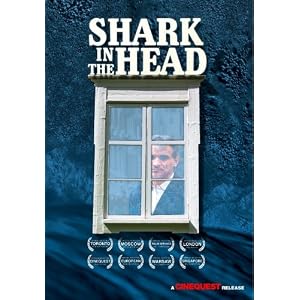
- Shark in the Head
- Camera angles only show half of the person, or the car, and mostly dead space like blank walls and the building
- Camera is obviously not a perspective shot when we travel through the speaker to the other side to the man speaking into it.
- His life consists of smoking and sitting on the street trying to con people into talking to him with ducks and gifts
- Scenes have a fast pace and are sped up, showing the day dragging on with no one stopping to talk to him
- He fixed himself all up (his hair and shirt tucked in) even though it is still only pajamas and he is still just standing at his window
- OCD? He rearranges the trash cans to be placed in the same direction and is very upset when his window is blocked.
- While they are building and putting together pipes, music is created and it flows into a piano rift.
- These workers can't leave- constant company, what he wants
- You can tell time has passed with the sudden dim of the sun even though he never moved and we didn't experience all the time inbetween
- Is he looking for someone to talk to in the phone book since he is lonely?
- Phone number matches lotto number- savant?
- He has the mind of child the way he sees the tv and newspaper
- He sees many cartoons as the news and then a very real shark- his indication that he isn't enjoying it?
- His house is completely blank. He has no one or nothing to be there.
- Radio show says "goodnight children"
- He can handle the simplicity of life when it is seen so simple like through the shadows behind curtains. Doesn't know the real things they are saying, can just enjoy the scene.
- The world is there for him. People walk by for him, they dance and turn and look at him, he can color and draw his world however he wants, as simple and colorful as he wants.
- When he sees things like the news that he sees as scary, the bead is red. This may imply him not taking his meds. When he sees things like the peaceful beach, a boat, etc, the beads are clear. Does this imply he did take them? Are these his pills?
- He finds familiarity in his new friends. Woman resembles his mother.
- Originally thought the chalk drawing could have been his because it is child like, like him.
- He creates his own happiness, why is that wrong?
- One set for the entirety of the movie. A man and his window. We see outside in, and inside out. Yet, an extremely complex plot.
- Stylistic, this is his life. This had to be the entire set, yet they did so much with it, that you were not tired of it, because it had style and played into the story line.
- SCHIZOPHRENIA

- Memento
- Opening Scene: Tense hand holding a photograph that is fading instead of developing
- Time is moving backwards
- Narrator: diegetic or non-diegetic? Is this the characters thoughts to himself, like instructions, or is it narration only for the audience?
- He has a condition, no short-term memory
- Has a ring on his finger. Married, but no wife introduced yet
- You know who you WERE, but do you know who you ARE? What has happened since his accident that would change his identity that much?
- Same scene repeating, but farther back in the memory. Same outfit, day to day.
- Having no short term memory is like waking up again and again
- You learn to trust YOUR handwriting. Is it always his? What if he is being tricked?
- WHO is Sammy Jankis and why is he important to remember?
- Black and white scenes- finally a new outfit, flannel shirt. Different information is known here, more tattoos
- Natalie enjoys hearing him speak about his wife. Why are they both scratched and bruised?
- Who is on the phone? A cop? Someone with a copy of the report, someone who knows a lot about the case and is interested in helping solve it.
- "Memories are only an interpretation, they aren't a record." This shows that he doesn't trust other people's memory, however if he can't remember the record, or who put it down as record, what does it matter? They go hand-in-hand and he may be being tricked.
- Is he narrating his thoughts for the audience or does he think only he can hear them? His step-by-step processes of waking up and figuring out where he is and what has happened.
- Him and Natalie are both so "hurt" by losing someone and aren't over them, yet they can sleep with each other? Natalie is shady.
- Slept over before she has the cuts on her lip.
- Natalie is planting her own people for Lenny to kill-taking advantage of him.
- You have to burn Polaroids- as close to permanent as Lenny can get to. Must go through a lot of effort to erase something or someone. But once it is done, that's it and he IS able to forget when normal humans cannot just erase someone from their memory one day and wake up and it be permanent.
- Teddy always wants to take another car. Does he know that he is following him? Is Teddy the real John G. or is he trying to gently lead him away because he knows he has been mislead?
- He cannot remember to forget his wife. Normal memories for a human being cannot be erased by simply burning a photo. He HAS to face those memories.

- Opening credits-introduced to the Psycho theme, quick, urgent music
- Phoenix, AZ, December 11, 2:43PM
- Sister is going to be gone the whole weekend, she will be alone
- No money in the office over the weekend- trusts her with the responsibility
- Buying off unhappiness, not buying happiness
- She's packing for something, bringing important papers and jewelry- assumed long term
- Imaging the conversations between her and sam, Mr. Cassidy and business owner, secretary and business owner
- Psycho theme (music) as she sees her boss while leaving town
- Being very suspicious to cop, making herself obvious
- Psycho theme again and she is driving away and cop is "following" her
- "You are in a hurry, is somebody chasin' ya?" IRONIC use of words
- Camera angle from a high corner of the restroom, then a point of view shot of her counting the money
- Imagining a conversation with Mr. Cassidy who threatens her life if he doesn't get her money back
- Rain creates a setting for accidents, and scary tones
- Shadows of a woman in the window of the main house
- "Didn't hear you in the rain" -No one will
- Especially since no one stops there now that it is off the main road- No one to help
- Marion actually hears the arguments between mother and son, Norman.
- Doesn't want to go into Marion's room?
- Music allows for us to be a little scared with Marion as she looks around and notices stuffed birds and creepy objects
- Norman is socially awkward- you begin to sympathize with him for having a neglectful mother who is such a huge responsibility now.
- "A boy's best friend is his mother"
- He has clearly been in a mad house!!
- knows all about the "laughing" and "judging eyes"
- Protective of his mother, even though she is a burden
- Norman's tone is very shifty
- We all go a little mad sometimes
- Shot through the hold includes the jagged drywall, creates a creepy frame
- Clear shower curtain, can see the blurred figures through it
- Blood flowing down the drain, hand reaching out, but never see an actual wound or where she is stabbed
- Is it mother? too much hair to be Norman
- Shower is still running
- Money is still on the bedside table, not the reason for the murder
- Shot of just a bloody hand much more meaningful- what don't we see?
- Very methodcial and well planned when covering up the murder, knows just what to look for, what to cover up and where to stow her and the car
- No one benefits from the money
- I'm not capable of being fooled, Mom did.
- If she fooled me, she didn't fool my mother.
- Wait, so he was or wasn't fooled?
- Norman continues to have a strange smirk on his face. He is somehow happy about this murder and hiding it
- Stabbing is not actually seen, just the knife being raised over and over
- When Marion's sister is walking up to the house, camera is at an angle following her feet- everything is very hilly, uneven, and overgrown
- Going crazy would be an extreme reaction says Norman- MADHOUSE.
- Room still decorated like a child's. Mind of a child?
- Crimes of passion, NOT OF PROFIT- no money
- Mother's voice- diegesis
- Subliminal message, face turns into a skull

- Syuzhet
- Chronological throughout film (no flashbacks/forwards)
- Basic training, graduation
- Some time passes between
- Vietname war- first station, travelling to find Cowboy
- Non-Diegetic
- Music opening each scene
- Music throughout the movie
- Diegetic
- Once the sergeant passes men in the barracks, they still are there once the camera leaves them
- Sergeant chanting while men march
- Gunshots
- Both??
- Narrator throughout the movie
- Speech at graduation
- Structure/Frame
- Easy, smooth fades from scene to scene.
- Wide angle shots, capturing action from the entire scene, not one area.
- Finally perspective shots at the end. Perspective of both soldiers and the enemy.
- When 8 Ball is being shot, very intense, slow motion shots, close and personal.
- Visual and Auditory Effects
- Shows Pyle's improvement through slow motion clips
- Speaking is limited to screaming and orders at the beginning of the film- no character dialogue.
- Narrator is not consistent. Who is it? Writing letters or a journal?
- Lasting echoes of Pyle crying while focused on Joker's face, creates a lasting, impressionable effect
- Music opening each scene is popular movie from the era of the War. Not a score.
- Hair growth= time has passed, maturity, identity is back
- Cars racing in front of the character, not focused on one person, but overall shots of the scence, wide angled shots
- Camera runs with soldiers, becoming part of the action, view point from a soldier
- Shot through the eyes of the enemy?
- DUALITY OF MAN.
- Fire lights Joker's face while he shoots the girl.
- Closing scene-haunting, singing the Mickey Mouse Club theme song. Very aware that they have been effected by the entire war, lost their innocence.

